Arab governments are moving towards restricting access to information, while Iraq prepares to legislate a law opposed by activists.
September 15, 2023
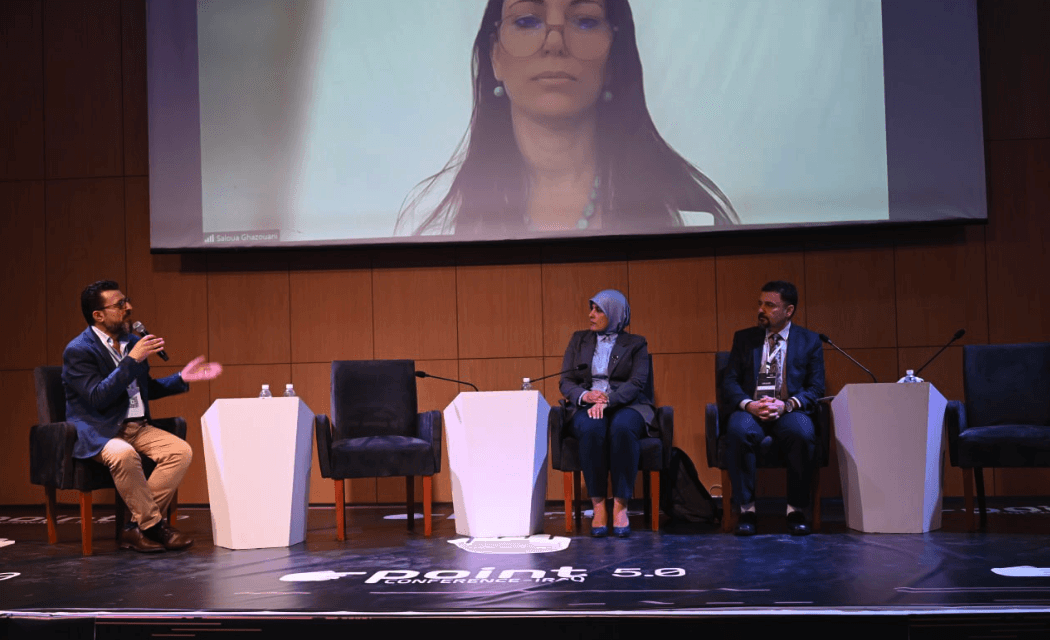
"When will information be released in the Arab region?" The participants in the second session of The Point Iraq Conference, in its fifth edition, unanimously provided one answer: "It won't happen soon. Instead, Arab countries are progressing in restricting the right to access information." They warned of the danger of concealing information and not allowing citizens to access it transparently, as it would be a major cause of systematic ignorance.
The second session of The Point Iraq Conference featured speakers such as the Regional Director of Article 19 in Tunisia, Saloua al-Ghazwani, the Director of the Ghraib Initiative in Lebanon Assaad Thebian, the legal advisor to I WATCH Initiative in Tunisia Azza Al-Khumairi, in addition to the President of the Namaa Journalistic Foundation, Amal Saqr, and the specialist in defending press freedom from the Kurdistan Region, Karwan Najib, Facilitated by General Coordinator of Network of Lawyers for Freedom of Expression, Dlovan Barwari.
In an overview of the situation in the Arab region and the impact of political changes on the right to access information, Saloua al-Ghazwani, the Regional Director of Article 19, pointed out that there are only five Arab constitutions that guarantee the right to access information, and Iraq, Jordan, Kuwait, Lebanon, and Yemen are not among them. Some of these countries have enacted laws to address this issue, while others are in the process of legislating it.
Al-Ghazwani noted that each country has its own experience in legislating the right to access information, starting with Jordan, which was the first to enact such a law. Kuwait, on the other hand, recently voted on and passed such legislation. However, in most cases, these laws have come about due to international pressure or an attempt to improve the country's image in the international community. Some have also resulted from what is known as the Arab Spring, leading to legal and constitutional amendments.
In summary, it appears that countries in the Arab region are seeking to enact laws to improve their image rather than demonstrating a genuine commitment to enforcing the right to access information, as noted by Dlovan Barwari.
The experience of Lebanon is unique in this regard, as highlighted by Assaad Thebian, the Director of the Gherbal Initiative. He explained, "Gherbal was founded in 2018, and we started by monitoring government contracts by submitting requests to the General Directorate (of the government)."
Thebian added that "our work evolved over the years, and we began to compile a list of all contracts signed by government institutions. We obtained a large number of documents, some in paper form and others in PDF, and we classified these documents and presented them to the public through the Gherbal website." He noted that they "publish the financial budget, the number of prisoners, reports from customs, and all the data held by government institutions."
Thebian emphasized that the foundation of the Gherbal Initiative is to act as a bridge between the two parties (the government and the citizens). Through their publications, they have achieved several goals, including facilitating access to data for citizens. They created a user-friendly website where documents and records are categorized, and a comprehensive map of all government departments and institutions is available. Users can search for any word, and the results will display all documents containing that word.
Furthermore, Thebian explained, "We also provide details of every contract, the parties involved, and through it, you can find out the number of contracts for a single company with government institutions." He shared a success story: "Not too long ago, a Lebanese singer passed away in a car accident on a road. Through Gherbal, we discovered that there was a maintenance contract for this road with a substantial amount of money, but the contract had not been executed, leading to the accident. With this evidence, it's possible to hold the negligent company accountable."
Today, several investigative journalists in Lebanon rely on the Gherbal Initiative website for their investigative work.As for Tunisia, which was a model for freedom, Azza Al-Khumairi stated that the right to access information has been significantly affected by the new political reality.Al-Khumairi explained that "the right to access information in Tunisia has been considered based on national and international standards. The constitution has guaranteed the right to access information since the 2014 constitution, and the same provision was reiterated in the 2022 constitution.
This law was introduced to enhance the principles of transparency, and accountability, and improve government services and their quality."Al-Khumairi continued by stating, "The Access to Information Authority has announced that it has adjudicated in more than 1000 cases where access to information was denied by a state institution." She explained that "this is a positive indicator that citizens are aware of their rights and know that if their access to information is denied, they can appeal this refusal.""However, over the past two years, many requests to access information have been denied, and there have been cases where requests for information were refused from the outset because there is a time limit calculated from the date of receiving the request, and legal action is taken after this period. Therefore, refusing to receive the request is a hindrance to the exercise of the right to access and the right to appeal," Al-Khumairi continued. She added, "Some institutions even refuse to issue a receipt of receipt, and some institutions add conditions that are not present in the law."She emphasized that the response rate over the past two years has dropped to around 20%, while the refusal rate for information requests has increased to 80%."Where is Iraq heading regarding the right to access information? Suppression or disclosure?" Amal Saqr exclaimed, saying, "Suppression, suppression, suppression.""We reject the legislation of such laws in Iraq (the Right to Access Information Act) because there is a lack of trust in the legislative body. Initially, the existence of a draft law is not announced until a date is set for the first reading in parliament, so how can we trust them to legislate a law that guarantees the right to access information without restrictions?" she questioned.Saqr further explains that "the basis for refusal is the existence of a policy of keeping citizens in the dark. There is no policy to promote democratic principles in Iraq by decision-makers, and there is no intention to involve citizens in decision-making.
" She points out that "the problem with political parties is that they do not understand the freedom of information, and they deliberately suppress it, as they try to protect themselves from corruption and wrongdoing."She mentions the existence of "political mentalities that still believe in the need to hide information and prevent citizens from having a political opinion," adding that "sharing information with citizens improves the relationship between the political class and citizens, and it prevents citizens from becoming victims of forgery and deception. It enables citizens to form informed opinions when participating in protests or expressing their views."Saqr emphasizes that the right to access information must be respected, and citizens must also respect it to avoid falling into the trap of ignorance. "Making information accessible benefits researchers and journalists and reveals the truth," she concludes.Saqr also didn't fail to mention that "the proposed law in Parliament does not meet any of the requirements of the right to access information. Moreover, there is no foundation and environment for implementing this law if it is legislated. It was supposed to come after the implementation of the Good Governance project, governance preparation, and data archiving."The Parliament of the Kurdistan Region of Iraq had previously enacted a right to access information law in 2013, but as Karwan Najib, a specialist in defending press freedom, explains, it wasn't taken seriously and had no impact.
Najib clarifies that in the Kurdistan Region, "the law has been in place for ten years, but has it really been implemented? No, it has not been implemented because the relevant institutions have not issued the necessary instructions for its implementation."Furthermore, he points out that "the Independent Human Rights Commission, which is responsible for monitoring and implementing the law, has no authority over other institutions."So, laws on the right to access information in the Arab region seem to be more about improving reputation rather than actual implementation, and Iraq is heading in that direction because it has not adhered to the international standards provided by Article 19 for guidance in legislating access to information laws, as emphasized by Dlovan Barwari.
Gallery
Memories from past Events
Content







FAQ
Frequently Asked Question
I have a question
When and where will the next conference take place?
The conference will be held on June 24–25, 2024 in Sarajevo at Dom Mladih.
Who can attend the conference?
How can I register to attend?
Will the conference be live-streamed?




Partners




Tawasoul Organization for Youth Empowerment · Iraq – Baghdad – Karradah city
+964 770 790 6400
Tawasoul Organization for Youth Empowerment · Iraq – Baghdad – Karradah city ·
Mobile: +964 770 211 1332
Copyright©2025.Pointiraq. All Right Reserved.